 Spearhead Capital Group
EXECUTIVE SUMMARY
Venezuela’s political transition has begun, and it is early, uneven, and reversible. This Fund exists for investors who share one view: that normalization proceeds. “We do not present certainty. We present an asymmetry, priced — resort keys at under a fifth of the region’s last major portfolio trade, and beachfront at a tenth of its own prior pricing.” That asymmetry is what the view costs today — and it is also what protects capital if the view proves wrong.
On January 3, 2026, U.S. forces captured Nicolás Maduro and brought him to the U.S. to face narco-terrorism charges, ending a regime that had suppressed Venezuelan economic activity for over a decade. The transition is already producing tangible results: energy sector sanctions eased in mid-April 2026, diplomatic relations reestablished, the U.S. Commerce Department actively facilitating U.S. business engagement, and debt restructuring talks formally authorized in May 2026. BlackRock’s Larry Fink — the head of the world’s largest asset manager — declared publicly that he is “quite bullish” on Venezuela. Institutional capital is not waiting for a perfect outcome; it is arriving now.
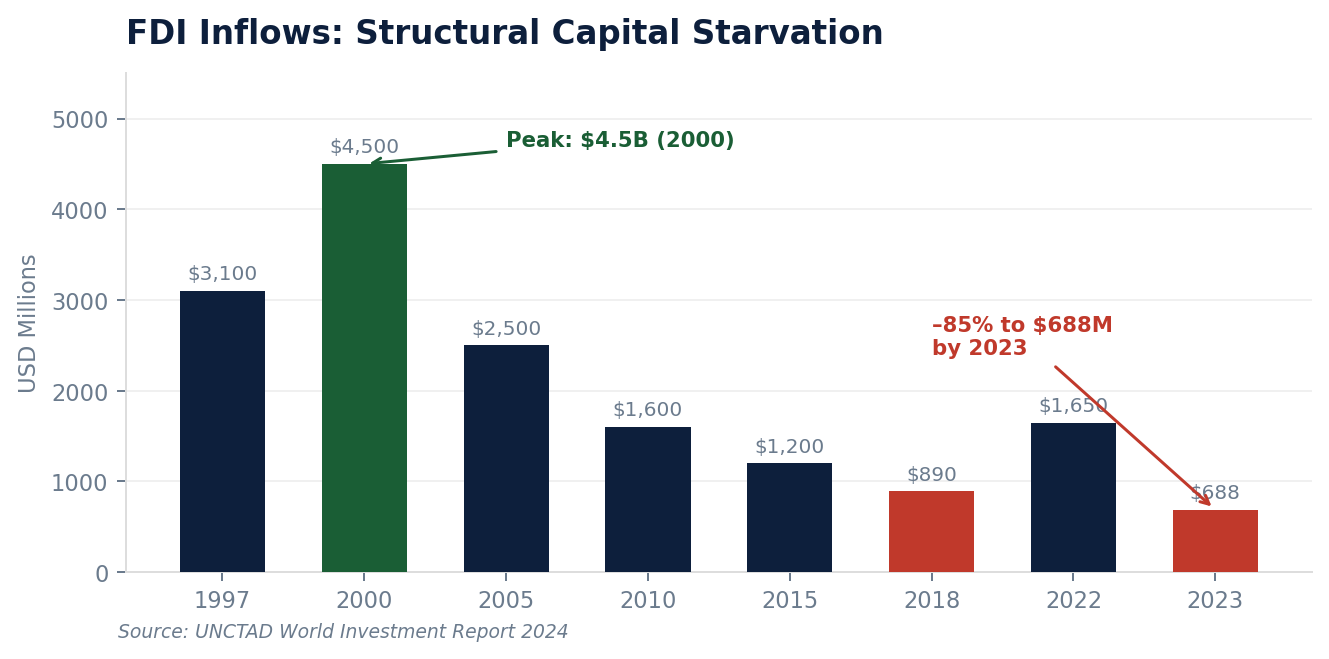
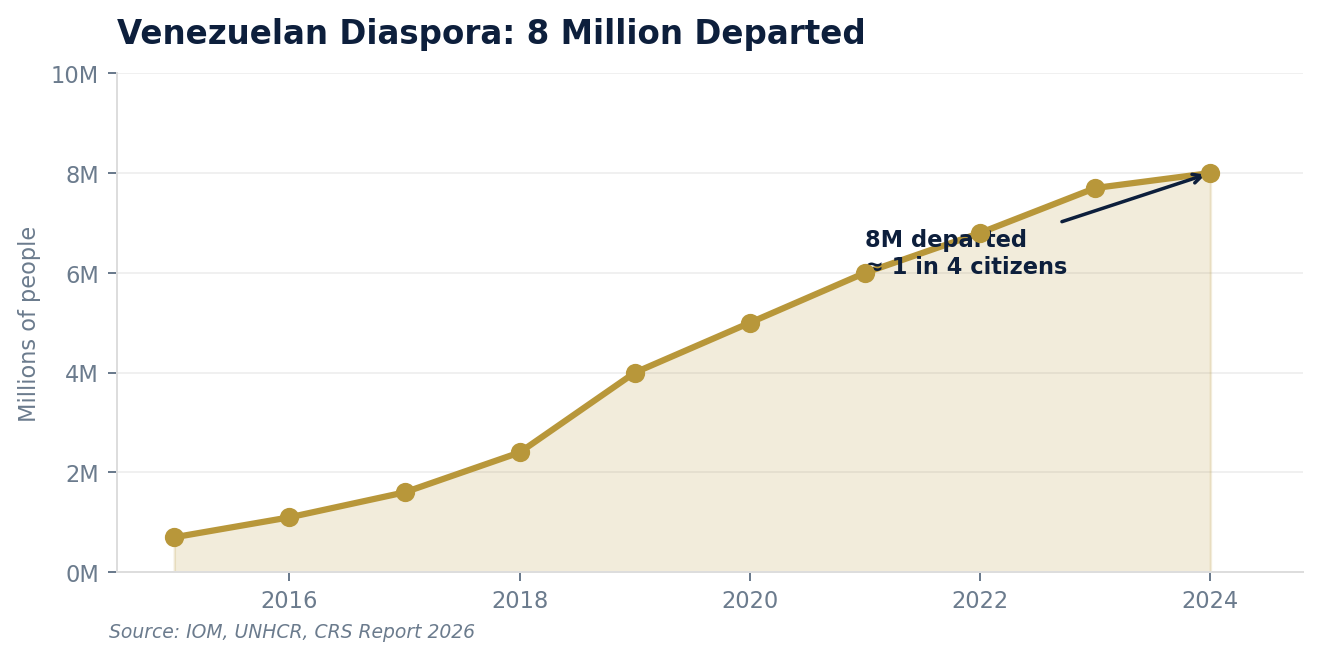
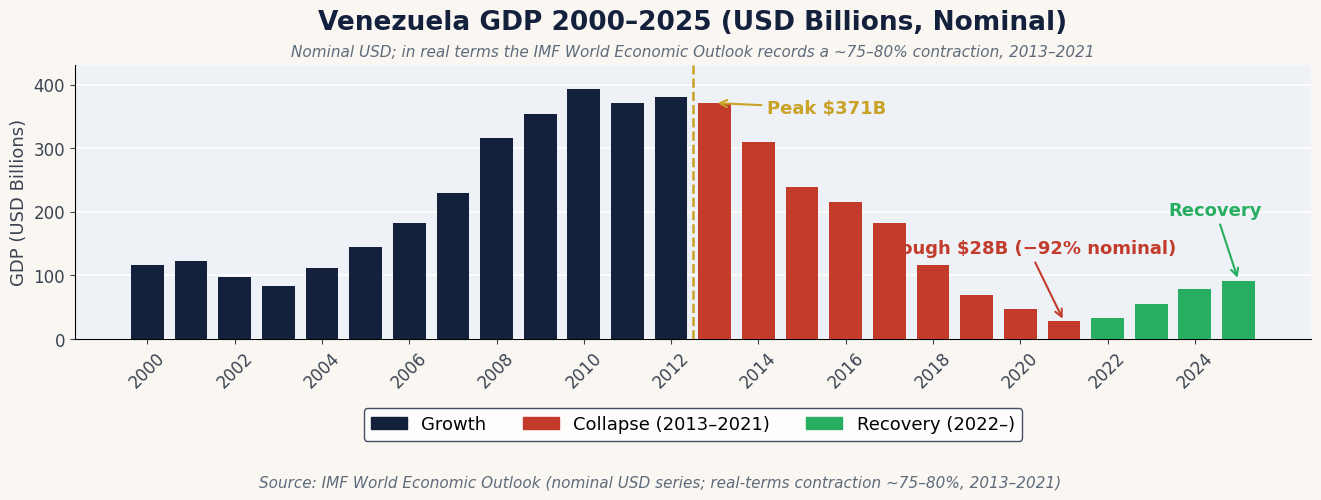
Over the prior decade, Venezuela’s GDP contracted by approximately 75–80% (2013–2021, IMF World Economic Outlook), the economy accumulated cumulative inflation of thousands of percent from 2014 through 2024, nearly 8 million citizens emigrated (CRS Report, 2026), and foreign direct investment collapsed from a 1997 peak of $3.1 billion to $688 million in 2023 — a 58.3% single-year decline (UNCTAD, Lloyd’s Bank Trade 2024). Isolated from Western capital for 17 years, its real estate market has been decimated. As a result, commercial real estate values have declined materially from historical peaks, transaction liquidity has all but ceased, and institutional capital has fully exited. This prospectus focuses on real estate investments — offering qualified investors the opportunity to acquire distressed assets, recapitalize, and exit within a target hold of 4–7 years per asset, inside the Fund’s 8-year term. Return targets are presented by scenario in Return Targets & Scenario Analysis and trace to the Fund’s pro forma model.
Today, high-quality assets in prime micro-locations trade at steep discounts to replacement cost and normalized income potential. Prime Caracas office values collapsed from a documented average of $5,500/m² in 2012 to ~$1,000/m² by 2020 — an 82% decline (FVI public-offering data via Banca y Negocios, Jun 2021) — one of the most extreme dislocations in modern real estate history. The window to acquire at distressed basis — before capital flows return — is open now.
POLITICAL CONTEXT: THE INFLECTION POINT
Venezuela’s economic collapse — a product of 27 years of resource nationalism, authoritarian mismanagement, and international isolation — created the precise conditions that define this investment opportunity. GDP contracted approximately 75–80% between 2013 and 2021 (IMF WEO), inflation peaked at over one million percent annually, and nearly 8 million citizens emigrated. The destruction of institutional capacity, foreign investment frameworks, and property rights is what suppressed asset prices to today’s distressed levels — and what makes entry now so compelling.
On January 3, 2026, U.S. forces captured Nicolás Maduro, ending his presidency and triggering an immediate policy response from Washington. Delcy Rodríguez was sworn in as interim president on January 5 and leads the transitional government. The Trump administration has moved with notable speed: energy sector sanctions on Venezuela’s central bank were eased in mid-April 2026, diplomatic relations have been formally reestablished, and the U.S. Commerce Department has launched a dedicated Venezuela Business Information Center to actively support U.S. companies entering the market. In May 2026, the U.S. government authorized Venezuela to hire advisers for potential debt restructuring talks — a formal milestone on the path to resolving the country’s $60 billion pile of defaulted bonds. Interior Secretary Doug Burgum led a Cabinet-level delegation to Caracas that included executives from Shell, Halliburton, and SLB. The pace of institutional re-engagement is accelerating.
The investment community has responded decisively. Venezuela’s sovereign bonds — single digits after 2018 sanctions → nearly doubled through 2025 under U.S. pressure → ~40–43¢ within days of the capture (Bloomberg, Tradeweb) — are approaching analyst recovery estimates of 50–60¢ (as of Q1 2026). BlackRock CEO Larry Fink — the head of the world’s largest asset manager — publicly declared in May 2026 that he is “quite bullish on the opportunity to invest in Venezuela,” adding that the country could be brought “back into its glory.” Veteran emerging market fund managers who have met directly with interim president Delcy Rodríguez in Caracas describe Venezuela as “the biggest opportunity in emerging markets,” citing positive reform momentum including the overhaul of Venezuela’s mining investment framework. Elections are broadly expected in late 2027 or early 2028, with both the Rodríguez government and the opposition incentivized to demonstrate economic progress beforehand.
The political path to full normalization will not be linear. But the directional shift is unambiguous: a U.S.-aligned government is in power, sanctions are being dismantled sector by sector, the world’s largest asset manager is publicly bullish, and sovereign capital markets are already repricing. Spearhead Capital Group is deploying into this window — before the consensus catches up.
The investment case for Venezuela has long rested on a clear-eyed assessment of asymmetric risk: acquire at deeply distressed basis while uncertainty is at its peak, and benefit disproportionately as conditions normalize — even partially. That thesis no longer requires a future assumption. The defining catalyst has arrived.
Maduro's Capture and the Post-Regime Transition
On January 3, 2026, U.S. Delta Force operatives captured Nicolás Maduro. Maduro was transported to New York, where he faces narco-terrorism and drug trafficking charges. President Trump declared the United States would lead Venezuela's transition to a stable, market-oriented government. The administration has followed through with speed: central bank sanctions eased in mid-April 2026, debt restructuring talks formally authorized in May 2026, and a Cabinet-level trade delegation dispatched to Caracas including Shell, Halliburton, and SLB executives. BlackRock CEO Larry Fink publicly declared in May 2026 that he is “quite bullish on the opportunity to invest in Venezuela” (Bloomberg, May 2026).
A January 2026 nationwide survey found 83% of Venezuelans optimistic and 68% calling for elections within a year (CSIS, March 2026). Hundreds of political prisoners have been released. Venezuela's sovereign bonds re-rated to ~40–43¢ within days of the capture (Bloomberg, Tradeweb) — approaching analyst recovery estimates of 50–60¢ (as of Q1 2026), debt markets already pricing in a credible restructuring pathway.
The transition is not without risk. Institutional fragility, entrenched corruption, and residual armed networks remain real operational challenges. U.S. sanctions, while actively being dismantled, have not been fully lifted — transactions with the Government of Venezuela, PdVSA, and approximately 190 individuals on the OFAC SDN list remain prohibited absent a specific license. Investors must conduct proper counterparty diligence under applicable OFAC general license parameters (U.S. Dept. of Commerce, trade.gov, May 2026). This strategy does not require a perfect outcome — it requires only directional improvement from today's deeply suppressed levels, a threshold each successive U.S. policy action is actively reinforcing.
The Normalization Pathway
- Gradual unwinding of U.S. and international sanctions, reopening Venezuela to global capital markets
- Re-engagement with multilateral institutions (IMF, World Bank, IDB) enabling sovereign financing access; U.S. authorization of debt restructuring advisers (May 2026) formally opens the $60B defaulted bond workout process
- Return of foreign direct investment, which collapsed from a $3.1B peak (1997) to $688M in 2023 (UNCTAD 2024)
- Repatriation of nearly 8 million diaspora Venezuelans contributing an estimated ~$4B annually in remittances (Inter-American Dialogue, 2022)
- Revival of business travel supporting Caracas hospitality demand — already underway with Cabinet-level U.S. delegations including Shell, Halliburton, and SLB visiting Caracas in 2026
- Recovery of leisure tourism to Margarita Island — arrivals already grew 94% in 2024 before Maduro's capture
WHY VENEZUELA: KEY ASPECTS OF THE OPPORTUNITY
Five interlocking factors make Venezuela an exceptional opportunistic real estate setup relative to other frontier markets today. Each is powerful in isolation; together they form a rare, dated entry point.
1. Unmatched Resource-Driven Growth Potential
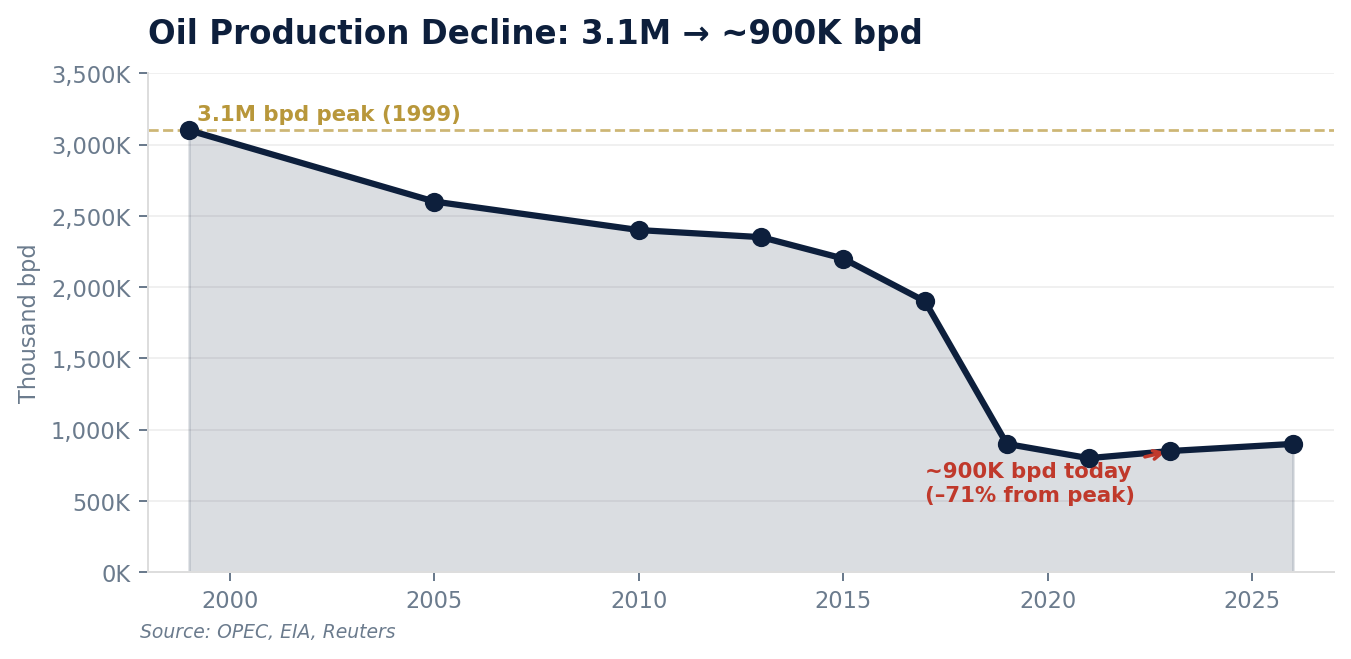
Venezuela possesses a natural resource base with no peer in the Western Hemisphere. It holds the world’s largest proven oil reserves — 303 billion barrels per OPEC’s 2025 Annual Statistical Bulletin, representing 17% of the global total — alongside an unparalleled base of critical mineral wealth including iron ore, bauxite, gold, coltan (essential to EV and technology supply chains), diamonds, copper, nickel, and reported uranium occurrences, primarily concentrated in the mineral-rich Guayana Shield. Venezuela also holds the seventh-largest natural gas reserves globally at 221 trillion cubic feet. No other country combines hydrocarbon and strategic mineral endowment at this scale. Note: Venezuela’s crude is predominantly heavy oil requiring specialized extraction; the 303 billion barrel figure is self-reported to OPEC and some independent analysts estimate recoverable reserves conservatively at 100–110 billion barrels — still the largest in the world and sufficient to support a generational production revival.
IMF normalization scenario projections suggest GDP growth of 8–15% annually once Venezuela reintegrates into the global economy — a trajectory that would rival Guyana’s extraordinary 38% GDP surge in 2024 following its offshore oil activation. These are scenario projections, not IMF base case forecasts; they are cited to illustrate the magnitude of potential normalization upside. Real estate fundamentals in resource-boom economies reprice rapidly and durably. Venezuela is positioned for that same structural rerating.
2. Severely Undervalued Real Estate Market — Pure Arbitrage
Three converging forces define the market dislocation and its rebound catalyst. Historical Closure: two decades of expropriation risk and capital controls — compounded by formal sanctions isolation since 2017 — have decimated real estate values — prime office prices down ~82% from the documented 2012 average — $5,500/m² → ~$1,000/m² by 2020 (FVI public-offering data) — one of the most severe dislocations in modern real estate history. Prime built assets on Margarita Island and in Caracas are currently available at $500–$2,000 per square meter ($46–$186 PSF) — with beachfront land at $200–$500 per square meter ($19–$46 PSF) — compared to $3,800–$7,400 per square meter ($353–$687 PSF) for prime new-build product in comparable Latin American capitals and Caribbean resort markets (per-market sources: FipeZap — São Paulo; Urbania — Lima; Metrocuadrado/Ciencuadras — Bogotá; Zonaprop/Reporte Inmobiliario — Buenos Aires; all asking, 2025–26). This is not a modest discount — it is structural price arbitrage of a magnitude rarely available in any asset class, anywhere in the world. Regime Shift: the transition to a US-backed democratic government unlocks foreign direct investment that has been structurally blocked for nearly two decades. Undervaluation Inflection: prime assets at these prices, in a dollarized market where the second wave of institutional capital — real assets — has not yet arrived, represent a once-in-a-cycle entry point.
The rebound catalyst is already in motion. A US-aligned regime shift unlocks foreign direct investment that has been structurally blocked for a decade. Chevron’s 2023 licenses — granted under the prior administration as a sanctions exception — already lifted Venezuelan oil output by 20%, demonstrating the speed at which capital flows respond to policy normalization. International tourism arrivals are up 30%+ year-to-date, signaling real demand revival ahead of full political resolution.
| CARACAS TROPHY CLASS A OFFICE · USD/m² (PSF) | LEVEL | BASIS |
|---|---|---|
| Realistic closed basis today | $1,400–2,000/m² ($130–186 PSF) | Closed — ~50–91% of asking (Cámara Inmobiliaria Metropolitana) |
| Fund entry — all-in hard cap | $2,000/m² ($186 PSF) | Acquisition + fit-out + closing · investment guidelines |
| Current Class A asking | $2,700–3,900/m² ($251–362 PSF) | Asking — Torre Digitel ~$3,896 · Torre Nest $3,600–3,750 · Bancaracas ~$2,727 · Luxor $2,600–2,700 (2025–26 listings) |
| Base-case exit · yr 5–6 | $3,300/m² ($307 PSF) | ~60% of the tier’s documented 2012 average |
| Tier’s 2012 average = upside exit | $5,500/m² ($511 PSF) | FVI public-offering data (Banca y Negocios, Jun 2021) |
| 2007 maximum — ceiling reference only | ~$7,000/m² ($650 PSF) | TIR/FVI registered-transaction study (Banca y Negocios, Aug 2019) — never underwritten; fell to ~$1,000/m² avg by 2020 |
3. High-Return Value-Add Strategy
The operational playbook is straightforward and proven: acquire distressed, foreclosed, or underutilized assets at today’s suppressed prices; recapitalize and modernize to institutional operating standards; and exit within a target hold of 4–7 years per asset into a normalizing market. The combination of basis discount, operational improvement, and macro repricing drives the Fund’s upside case — 6.8× gross / 5.2× net MOIC at full repricing, per the pro forma model — a return profile unavailable in any liquid or efficiently priced market.
This is the same playbook executed by the most successful emerging market real estate investors of the past three decades — in Eastern Europe post-1989, in Southeast Asia post-1997, and in the Gulf States pre-2000. The discipline is in identifying the right assets, at the right basis, before the crowd arrives.
4. Timing — A Perfect Storm of Catalysts
Rarely do this many independent catalysts converge simultaneously. Each alone would justify attention. Together, they create a window that is both time-limited and asymmetric:
- Maduro’s January 2026 capture by U.S. forces — removing the primary political obstacle to normalization
- Sanctions relief pathway opening, with U.S. and multilateral institutions signaling conditional re-engagement
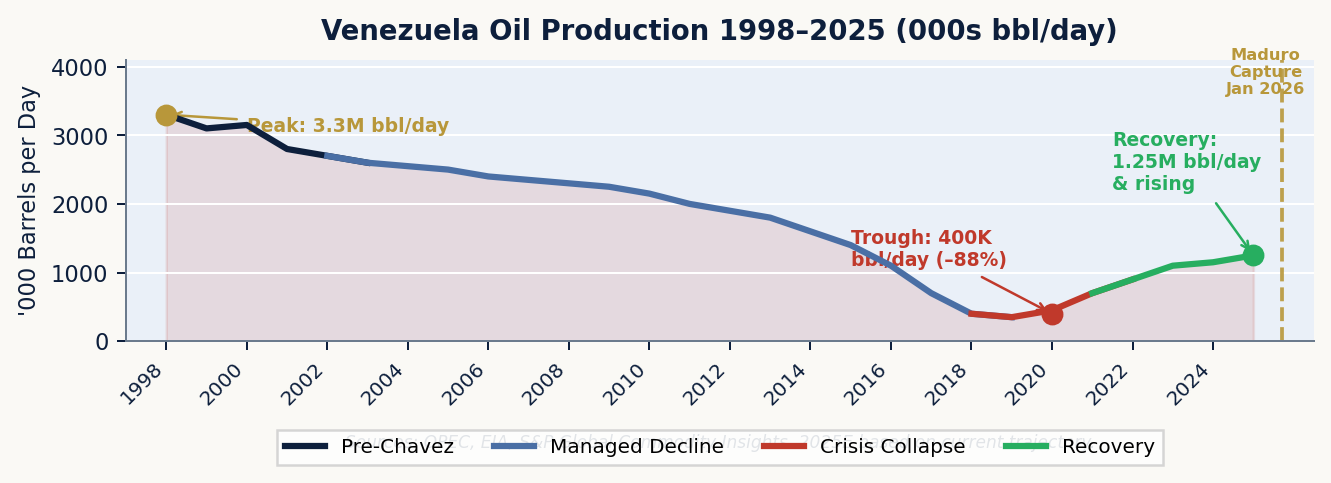
- Global oil industry re-engagement, with U.S. companies explicitly invited to rebuild Venezuela’s production infrastructure
- Critical minerals supercycle — global demand for lithium, coltan, and gold creating structural inbound investment pressure independent of political outcomes
- Diaspora capital mobilization — nearly 8 million Venezuelans abroad with accumulated hard-currency savings and deep motivation to participate in their country’s rebuilding
- Tourism recovery already underway — international arrivals up 94% in 2024, before political resolution, demonstrating demand that is independent of governance uncertainty
5. Risk-Adjusted Asymmetric Upside
The asymmetry of this opportunity is its defining characteristic. Downside is protected by rock-bottom entry prices — assets acquired at 50–90% below historical peaks retain intrinsic utility regardless of political outcome. A beachfront Margarita hotel or a core Las Mercedes retail asset has value as a functioning asset independent of who governs Venezuela. The hard asset floor is real.
Upside, by contrast, is uncapped. A natural resources supercycle — driven simultaneously by oil, lithium, coltan, and gold — compounding on top of a democratic normalization and diaspora capital return creates the conditions for a decade-defining asset repricing. This is the Dubai pre-2000s setup: a market that looks uninvestable to the consensus but is, in fact, on the cusp of a structural transformation that will make today’s prices look absurd in retrospect.
THE INVESTMENT OPPORTUNITY
A Market Operating Far Below Historical Capacity
Prior to its crisis, Venezuela was one of Latin America's most developed and urbanized countries — with the world's largest proven oil reserves, established commercial corridors, modern residential districts, and a mature hospitality infrastructure. That physical framework remains. What collapsed was economic confidence, rule of law, and capital access — not the underlying real asset base.
Venezuela's GDP contracted approximately 75–80% between 2013 and 2021 (IMF World Economic Outlook), placing it among the most severe peacetime economic collapses in modern history. Foreign companies — including General Motors, Kimberly-Clark, Exxon Mobil, Kellogg's, United Airlines, and Delta Airlines — exited, often surrendering assets rather than selling at market (Lloyd's Bank Trade). Current pricing reflects that dysfunction, not underlying value.
Current Market Conditions
- Office vacancy in metro Caracas: ~50% of stock — excluding government towers that are also largely vacant (TIR/FVI registered-transaction study via Banca y Negocios, Aug 2019)
- Prime office values approximately 82% below the 2012 documented average — $5,500/m² → ~$1,000/m² by 2020 (FVI public-offering data)
- Sub-$50K properties take over a year to sell — illustrating the illiquidity premium embedded in today's pricing
- De facto dollarization — transactions already in USD, removing currency mismatch risk for hard-currency investors
- International tourist arrivals grew 90% in 2023 and 94% in 2024 — before Maduro's removal (Caracas Chronicles, Venezuela Tourism Ministry)
The Counterargument — and Why It Misses the Mark
Skeptics correctly note that prime micro-market assets in Las Mercedes and Altamira now ask $2,000–$3,000 per square meter ($186–$279 PSF) in hard USD (Cámara Inmobiliaria Metropolitana — current $2,000–2,500/m², with closings documented at ~50–91% of asking). This observation is accurate but incomplete. Our basis advantage rests on three compounding factors headline price does not capture:
- No real-asset institutional bid yet — institutional capital is returning in two waves, sovereign debt and energy first (under way now, and the source of future exit demand), real assets later; today all transactions are cash with no mortgage market, no foreign institutional buyers, and motivated sellers with no alternative liquidity
- The illiquidity premium — a market where properties take over a year to sell is not efficiently priced; sellers accept discounts to income-based valuations in exchange for liquidity
- Normalization upside — risk premiums for political, legal, and operational risk are priced at peak uncertainty; any compression reprices assets disproportionately
INVESTMENT FOCUS
The vehicle will concentrate acquisition activity on Margarita Island and in Caracas — the two markets most likely to demonstrate early improvement as conditions stabilize. The portfolio is constructed 60/20/20 by deployed equity: Margarita land $16.5M — the appreciation engine (Land I & II plus Land III at the same ~$222/m² basis — all modeled acquisition targets); Margarita hospitality $5.5M — ~85 keys of repositioning upside (asset mapping is a pipeline decision); and Caracas trophy Class A office $5.5M — hard-currency income from year 2 plus downside support.
Margarita Island — Caribbean Tourism & Early Recovery Leader
Margarita Island is Venezuela's premier leisure destination — a Caribbean island with white-sand beaches, duty-free status, and established resort infrastructure. Tourism recovery data prior to Maduro's removal was already compelling:
- 2.8M international arrivals Jan–Oct 2025, following consecutive years of high-double-digit growth (Venezuelan Ministry of Tourism); Margarita arrivals up ~20% in 2025 (Venezuelan Ministry of Tourism; no independent series available — Venezuela does not appear in CTO/CoStar regional reporting)
- First European cruise liner in 15 years docked in January 2023 — now a regular route (Caracas Chronicles)
- 280 direct international charter flights planned for 2025 from Russia, Poland, Italy, Spain, Cuba, Colombia (Venezuela Tourism Review)
- 557 tourism trade agreements signed with 15 countries at the August 2025 International Business Roundtable (Guacamaya)
Caracas — Capital, Commerce & First-Wave Return
Caracas is Venezuela's political, economic, and cultural capital. Prime districts — Las Mercedes, Altamira, Chacao, Sabana Grande — host established retail corridors, hospitality assets, and mixed-use developments that once supported robust commercial activity. Land scarcity and legacy infrastructure in core urban submarkets create durable competitive advantages over peripheral sites. Caracas is the primary destination for business travel, diplomatic activity, and diaspora return — making it the first market to benefit from corporate re-entry and institutional FDI.
The Fund’s office sleeve buys the capital’s best buildings at a discount: trophy Class A — the Torre Luxor / Torre Digitel / FVI-portfolio tier in Las Mercedes, La Castellana, Chacao, Altamira and El Rosal — at a $2,000/m² ($186 PSF) all-in hard cap, against current tier asks of $2,700–3,900/m² (asking; closings documented at ~50–91% of asking). Rents ($18/m²/month — Rent-A-House valores por m², May 2026) commence in year 2; the exit in years 5–6 is underwritten to $3,300/m² — only ~60% of the tier’s documented 2012 average of $5,500/m² (FVI public-offering data); full reversion to that average is the upside case, and the ~$7,000/m² 2007 maximum (TIR/FVI) is a ceiling reference only, never underwritten — it was followed by a crash to ~$1,000/m² average by 2020. Flight-to-quality support: JLL LatAm Office Overview H1 2025 bifurcation commentary, the in-market quality spread (new Las Mercedes $2,600–3,900 asking vs. older El Rosal stock $1,100–2,000 asking), and embassy-corridor demand concentration (Cámara Inmobiliaria Metropolitana). Caracas is the income and downside leg of the portfolio — the ~6× repricing claims in these materials are Margarita-hospitality-only.
Hotel Market Gap: Margarita vs. Caribbean Peers
Despite Margarita’s demonstrated tourism rebound, its hotel market metrics reveal extreme undervaluation relative to Caribbean peers. The table below compares current Margarita hotel performance against regional benchmarks — illustrating the magnitude of the revenue repricing opportunity embedded in hospitality asset acquisitions.
Beachfront Land: Margarita vs. the Region
Buy large beachfront parcels at today’s distressed basis. Sell permitted lots into recovery. Base-case exit below what comparable lots list for today — and a tenth of the region’s ceiling.
| Market | USD/m² (PSF) | What it is |
|---|---|---|
| Margarita Today — Fund entry basis | $220 ($20 PSF) | Large beachfront parcels at distressed basis |
| Cap Cana, Dominican Republic | ~$460 ($43 PSF) | Permitted villa lot inside the gates — interior, not beachfront |
| Base-case exit | $1,300 ($121 PSF) | Sold as permitted beachfront lots · 59% of Margarita’s own 2011 peak |
| Tulum, Mexico | $1,428–1,594 ($133–148 PSF) | Beachfront lots listed for sale today (Christie’s) |
| Margarita 2011 peak | $2,200 ($204 PSF) | Larger Seven Mile Beach tracts list at ~$1,600–1,900/m² — bracketing Margarita’s own prior peak |
| Seven Mile Beach, Grand Cayman | ~$11,900 ($1,105 PSF) | 0.61-acre direct-beachfront parcel, hotel/tourism zoned (CIREBA MLS #418731) — the region’s most institutionalized beachfront market — the ceiling; what completed markets cost |
| Built prime product — Punta Cana · Cancún · Aruba | $3,300–7,100 | Finished buildings, not land — the repricing ceiling for the Fund’s repositioned hotels |
Land comparables: Spearhead comp file, Exhibit C — verified listings, 2025–26; available on request. The entry basis is further corroborated by verified regional tract pricing (Exhibit C, Appendix A). Aruba appears in the built-product band only — its resort corridor sits predominantly on long-term government lease land, so no freehold beachfront land market exists to compare against.
| Market | Occupancy | ADR (USD/night) | RevPAR (est.) | ADR Upside |
|---|---|---|---|---|
| Margarita Island (Venezuela) | ~45–50% | ~$45–65 | ~$25–30 | Baseline |
| Caribbean Average | 64.5% | $349 | $230 | ~6.3× ADR |
| Dominican Republic | 67.2% | $236 | $159 | ~4.3× ADR |
| Jamaica | — | $321 | — | ~5.8× ADR |
| Aruba | — | $463 | — | ~8.4× ADR |
| Puerto Rico | — | $297 | — | ~5.4× ADR |
Sources: IRR Caribbean Hospitality Market Report Q1 2026 (CoStar data) — Caribbean 2025 ADR $349, RevPAR $230, occupancy 64.5%; performance above pre-pandemic peaks. Available on request. Venezuelan Ministry of Tourism (no independent series available). Margarita figures are Spearhead estimates derived from market data — no formal STR reporting exists for Venezuela; ~$55 is the midpoint of a $45–65 estimate.
Implication: Margarita’s current ADR of $45–65/night reflects crisis-era distress, not market fundamentals. Recovering to even half of the 2025 Caribbean average represents a 3–4× revenue uplift on existing hotel stock. Full normalization to the regional average implies ~6.3× revenue repricing — embedded in assets available today at 50–90% below 2013 replacement cost.
The Stabilized ADR Is Already Published On-Island
The Fund’s $190 stabilized ADR is not a projection of a future market — it sits in the lower half of the band the island’s current quality tier already publishes, today, before normalization: Island 4★ average $87 · 5★ average $149 (Booking.com, 379 properties) · Hesperia 5★ beachfront from $130 · Tibisay Boutique, Pampatar ≈$198/room (dbl occ.) · Wyndham Concorde, Porlamar — the island’s only international-flag resort — $275/night incl. breakfast · Cala Margarita Boutique & Spa $301 · Isabel La Católica, Pampatar $350 (direct quote). These prices clear on domestic-led demand, with no U.S. airlift and constrained international access. A full-scale branded resort already publishes 45% above the Fund’s stabilized assumption. The underwriting assumes only that repositioned beachfront assets reach a tier that already exists.
Published OTA rates, July 2026 (Google Hotels, Booking.com regional data, KAYAK); per-person portal rates converted at double occupancy; Isabel La Católica by direct quote, on file. Published rates are market-price evidence, not ADR performance data.
Rate Evidence — Verify Each Property Live
- 1 — Wyndham Concorde · Porlamar — $275/night incl. breakfast · the island’s only international-flag resort
- 2 — Tibisay Hotel Boutique · Pampatar — ≈$198/room (dbl occ.)
- 3 — Isabel La Católica · Pampatar — $350/night · direct quote, on file (link verifies the property; rate by direct quote)
- 4 — Cala Margarita Boutique & Spa · Paraguachí, nr. Playa El Tirano — $301/night · 5★, 4.8 (64 reviews)
- 5 — Hesperia Isla Margarita · Pedro González — 5★ beachfront · from $130
VERIFY LIVE: current island-wide availability and pricing → 379 properties · 3★ avg $46 · 4★ avg $87 · 5★ avg $149 (Booking.com). Fund stabilized ADR $190 — in the lower half of this observed band, pre-normalization. Published OTA rates, July 2026; rates fluctuate daily — links provided precisely so the reader can check.
What the Region Pays Per Key
| Hotel acquisitions · what the region pays per key · USD | Per key | Note |
|---|---|---|
| Venezuela Fund I — all-in basis | ~$65K/key | Acquisition + full repositioning capex |
| Grand Lucayan, Bahamas | $615,314/room | 196 rooms, acquired for redevelopment — a distressed, redevelopment-basis trade |
| Tortuga portfolio | $352,188/room | Hyatt’s 5,600-room exit across Mexico, Jamaica, DR — the region’s largest recent trade |
WHAT THE REGION PAYS PER KEY — The Fund’s all-in basis of ~$65K/key compares against the region’s notable trades of the trailing twelve months: $352,188/room — Hyatt’s sale of the 14-property, 5,600-room Tortuga portfolio (Mexico, Jamaica, DR) — and $615,314/room for the Grand Lucayan, Freeport, acquired for redevelopment. (IRR Caribbean Hospitality Market Report Q1 2026, CoStar data — available on request.) The Fund’s exits are underwritten on stabilized income at a 10% cap rate — no convergence toward these per-key marks is required or assumed. Any convergence is upside.
Primary Asset Targets
- Hospitality Properties: Core and resort hotels on Margarita and in Caracas with beachfront or prime-urban positioning and operational repositioning upside
- Retail and Mixed-Use: Well-located retail properties in high-density urban nodes benefiting from diaspora consumer spending and corporate tenant re-entry
- Prime Caracas Office: trophy Class A — the Torre Luxor / Torre Digitel / FVI-portfolio tier — at a $2,000/m² ($186 PSF) all-in hard cap; hard-currency rents from year 2; exit years 5–6 underwritten to $3,300/m², ~60% of the tier’s documented 2012 average (FVI)
CORE APPROACH — REAL ESTATE VALUE-ADD STRATEGY
- Step 1 — Acquire Distressed Assets: Target foreclosed, underutilized, and distressed properties in irreplaceable Margarita Island and Caracas locations, acquiring at 50–90% below historical peak prices — in the gap before the second wave of institutional capital arrives for real assets.
- Step 2 — Recapitalize & Modernize: Reposition assets for tourism, hospitality, residential, and commercial demand. Install private backup infrastructure. Upgrade to institutional operating standards. Generate hard-currency USD income during the hold period.
- Step 3 — Exit at Premium Valuations: Target hold of 4–7 years per asset, within the Fund’s 8-year term. Exits are underwritten in sequence — regional operators and local and diaspora family capital first, second-wave institutional capital as the premium bid behind them — with share sales at the SPE level as the preferred route. The no-buyer case is the downside scenario: hold for income at entry basis, with the two extension years ensuring no forced sale.
Exit Environment: Demand Recovering, Supply Tightening
Global hotel transaction volumes +22% in 2025 from the 2023 trough — Americas +27%; luxury resorts and trophy assets emerging as top investment targets on record dry powder (JLL Global Hotel Investment Outlook, Feb 2026).
SUPPLY IS TIGHTENING AS DEMAND STABILIZES — The Caribbean construction pipeline has contracted 12.1% since December 2023 — financing costs, construction costs, and insurance availability are keeping new supply out (IRR/CoStar Q1 2026; only four new projects started region-wide since March 2025). The Fund carries none of the three constraints: committed equity means no financing dependency; Margarita’s duty-free zone cuts imported build-out costs 20–30%; and repositioning existing stock sidesteps ground-up construction risk entirely. Repositioned keys arrive into a region that has stopped building.
STRATEGIC PRIORITIES
1. Irreplaceable, Defensible Locations
Beachfront Margarita parcels, core urban Caracas submarkets, and mixed-use nodes adjacent to civic hubs — locations where natural supply barriers prevent competitive dilution from new development.
2. Capital Preservation Through Asset Quality
The fund targets best-in-class assets within their micro-markets — irreplaceable locations trading at 50–90%+ discounts to intrinsic value. In frontier markets, quality of asset is the primary defense against downside. We are not buying distressed assets because they are cheap; we are buying exceptional assets that happen to be priced as if they are worthless.
3. Hard-Currency Revenue Positioning
USD-denominated leases in prime Caracas; tourism foreign exchange receipts in Margarita; diaspora tenant demand — all generating hard-currency cash flows to protect economic value in a dollarized but volatile environment.
4. Infrastructure-Resilient Operations
Power, water, and infrastructure constraints are treated as solvable operating challenges, not disqualifying risks. Private backup infrastructure is built into acquisition budgets and operating models — consistent with premium asset standards across frontier markets globally.
5. Phased, Disciplined Deployment
Capital deployed in phases against operational and macro milestones, not front-loaded. No leverage — all acquisitions are cash. Specific exit triggers: meaningful sanctions relief, institutional investor re-entry, or demonstrated rule-of-law stabilization sufficient to support institutional sale processes.
FUND TERMS & STRUCTURE
Venezuela Opportunistic Real Estate Fund I (the "Fund") is offered through Spearhead CCS/Margarita SPV I, a single committed-capital vehicle into which all LP capital is committed at one hard close, then deployed deal by deal across Caracas and Isla de Margarita. Each acquisition is held in its own wholly-owned SPE with a standalone, deal-level waterfall — one entry point and locked capital, combining the simplicity of a co-investment with the capital certainty of a fund.
Key Terms Summary
- Vehicle
- Venezuela Opportunistic Real Estate Fund I, offered through Spearhead CCS/Margarita SPV I — single committed-capital SPV, deployed deal by deal
- Fund Manager
- Spearhead Capital Group (GP: Spearhead Capital Group GP LLC)
- Strategy
- Opportunistic real estate — distressed acquisition, hold through normalization
- Target Raise
- $25M – $30M
- Minimum Commitment
- $1,000,000
- Vehicle Type
- Delaware LLC / LP; one wholly-owned SPE per asset
- Fund Term
- 8 years from final close, with two 1-year GP extensions
- Deployment Period
- 6–24 months
- Hard Close
- 60–90 days · no re-opens
- Target Geographies
- Caracas (Las Mercedes, Altamira, Chacao) and Margarita Island, Venezuela
- Target Asset Types
- Distressed hospitality, retail / mixed-use & opportunistic commercial
- Fund Currency
- U.S. Dollars (USD)
- Distributions
- Upon asset realization; no mandatory current income during hold
- Reporting
- Quarterly, plus event-driven notices for acquisitions, dispositions, and material events
- Cross-Collateralization
- None — each deal settles its own waterfall at the SPE level
- Capital-Call Notice
- 10–15 business days
- Eligible Investors
- Accredited investors and qualified purchasers only
Fee Structure
- Management Fee
- 2.0% per annum on deployed capital only — LPs pay no fee on committed but uncalled capital
- Carried Interest
- 20% of profits above the 8% preferred return, settled per deal. Carried interest is subject to a fund-level clawback; see Carry Clawback below
- Preferred Return (Hurdle)
- 8% per annum, simple, on called capital — the GP earns zero carry until LPs have received full return of capital plus the 8% preferred
- GP Catch-Up
- After the 8% pref is cleared, 100% of subsequent distributions flow to the GP until it has received 20% of all profits distributed to that point (shown at 100%; may be set to 50% in final LP documentation)
- Carried Interest Split
- 80% LP / 20% GP on all distributions above the catch-up threshold
- Acquisition Fee
- 2% acquisition fee on purchase price — compensates the GP for sourcing and execution and funds fund operations during deployment, when management fees (charged on deployed capital only) are still building. No offset
- OpCo Fee
- 3% flat of hotel property revenue (hospitality only), before NOI, charged at the property level
- Disposition Fee
- None
- Fund Expenses (organizational + administration)
- $150,000 per annum, borne by the Fund
- Carry Clawback
- At final liquidation, if aggregate LP distributions fall short of contributed capital, the GP entity returns previously distributed carry (net of taxes attributable thereto) up to the shortfall. 25% of each carry distribution is escrowed; escrowed amounts are released at any distribution date on which aggregate LP distributions equal or exceed contributed capital, with all subsequent carry distributed without holdback. The clawback is tested at wind-up only; interim realizations are not subject to mid-fund true-up. The obligation is that of the GP entity and is capped at carry actually received, net of tax
- GP Commitment
- $1,000,000, invested on identical terms to LPs and at risk ahead of any carry
RETURN TARGETS & SCENARIO ANALYSIS
The following return targets trace to the Fund's pro forma model (Spearhead_Fund_ProForma_v3.xlsx — available in the data room; scenario toggle at Assumptions!B4). Gross underwriting targets are set per acquisition; net figures are net of all fees, expenses, and carried interest. These are model outputs, not guarantees.
Gross Underwriting Targets by Strategy — Base Case, Asset Level
Gross underwriting targets per acquisition. Individual deals are underwritten to these hurdles before capital is called. At the Fund's contractual fee and carry terms, a 60/20/20 land–hospitality–Caracas office portfolio at these targets corresponds to:
Three-Scenario Analysis
| DOWNSIDE — NO RECOVERY (STRESS) | BASE — TRANSITION HOLDS | UPSIDE — FULL REPRICING | |
|---|---|---|---|
| Land exit | ~entry ($220/m² · ~$20 PSF) | $1,300/m² ($121 PSF · ~59% of 2011 peak) | $2,200/m² ($204 PSF · Margarita’s own 2011 peak) |
| Stabilized ADR | ~$55 (today) | $190 (~54% of the 2025 Caribbean average of $349; below the Dominican Republic’s $236) | $229 (~66% of the 2025 average) |
| Office exit (Caracas) | ~entry ($2,000/m² · rent from yr 2) | $3,300/m² ($307 PSF · ~60% of the tier’s 2012 avg of $5,500) | $5,500/m² ($511 PSF · full reversion to the 2012 avg) |
| Gross MOIC / IRR | 1.0× / ~1% | 4.3× / 40% | 7.1× / 57% |
| Net MOIC / IRR | 0.88× / ~(3)% | 3.4× / 32% | 5.4× / 48% |
Base case: a 60/20/20 land–hospitality–Caracas office portfolio; land recovery to ~59% of Margarita's own 2011 pricing; stabilized ADRs of ~$190 — ~54% of the 2025 Caribbean average of $349, below the Dominican Republic's $236; hotels exiting at stabilized income in the year 7–8 window (base case: year 7) at a 10% cap rate; and the Caracas office exiting in years 5–6 at $3,300/m² — ~60% of the tier's documented 2012 average of $5,500/m² (FVI public-offering data). Caracas rental income commences in year 2 inside its SPE; distributions commence in year 4, led by land exits.
The Downside assumes the transition stalls: no repricing, all three legs held for income and exited at entry basis — the income-producing office (rent from year 2) replaces part of the dark-hotel exposure, improving downside composition. The hard-asset intrinsic utility of beachfront and core-urban holdings supports capital — the quantified basis-as-insurance argument made in Risk Factors, whose primary risk (expropriation and political reversal) is the same political dependency underlying the base case.
The Base case assumes gradual, non-linear normalization: partial sanctions relief, a functioning transitional government, diaspora capital return, and Caracas reactivated as a regional business hub. Land recovers to ~59% of Margarita's own 2011 pricing; hotels stabilize at $190 ADR — still below the Dominican Republic's $236. Second-wave institutional buyers begin forming an exit pool as the Fund's realizations begin in year 4.
The Upside assumes full repricing to Margarita's 2011 peak — with ADRs at $229 (~66% of the 2025 Caribbean average) and cap-rate compression to 8.5%. International hotel brands and institutional buyers re-engage.
DISTRIBUTION WATERFALL — ILLUSTRATIVE BASE CASE
The following illustrates the distribution waterfall mechanics for a $20,000,000 fund achieving a 3.0x gross equity multiple over a 7-year hold period. This is a mechanics illustration only — not a fund projection; fund-level targets are in Return Targets & Scenario Analysis and trace to the pro forma model. All figures are illustrative and rounded for clarity.
Assumptions: $20M LP capital committed; zero GP co-invest in this illustration; 3.0x gross multiple = $60M total proceeds; 8% simple preferred return over 7 years = $11.2M, so return of capital plus preferred = $31.2M returned to LPs before the GP earns any carry.
| Waterfall Tier | Description | Amount (Base Case) | Recipient |
|---|---|---|---|
| Tier 1 — Return of Capital | 100% of invested LP capital returned before any promote | $20,000,000 | 100% LP |
| Tier 2 — Preferred Return | 8% per annum, simple, on called LP capital until full return | $11,200,000 | 100% LP |
| Tier 3 — GP Catch-Up | GP receives 100% of distributions until it has received 20% of total profit | ~$2,800,000 | 100% GP |
| Tier 4 — Carried Interest Split | Remaining profits split 80% LP / 20% GP | $26,000,000 total → $20.8M LP / $5.2M GP | 80% LP / 20% GP |
| MECHANICS ILLUSTRATION — $20M / 3.0x GROSS / 7-YEAR HOLD | LP: ~2.60× net on this illustration | GP Carry: ~$8.0M — subject to fund-level clawback; see Terms |
HISTORICAL PRECEDENT: DISTRESSED DISLOCATION → REPRICING
History is consistent: the strongest long-term real estate investment vintages are built during periods of maximum uncertainty. Venezuela is not unique in this dynamic.
- Colombia (Medellín, 2005–2015): Commercial real estate values rose 4–6x as security improved. Note: the Medellín parallel is instructive but imperfect — Colombia maintained stronger institutional continuity than Venezuela currently possesses. Cited as pattern evidence, not direct analog.
- Post-conflict Bosnia & Herzegovina (1996–2010): Prime Sarajevo real estate appreciated 8–10x from post-war lows as international presence normalized economic activity.
- Myanmar liberalization (2011–2015): Yangon hotel room rates doubled within three years of initial sanctions relief, driven by business travel re-entry ahead of broader normalization.
- Iraq — Kurdistan Region (2009–2015): Institutional investors achieving 3–5x returns as a functional sub-economy developed in a protected enclave — Margarita's island geography and special economic zone status offer a structural analog.
RISK FACTORS & MITIGANTS
Political & Transition Risk
Venezuela's transition is not guaranteed. The Chavista apparatus, armed colectivos, and Colombian guerrilla networks remain partially intact. CFR cautions that outcomes ranging from managed regime continuity to fragmentation remain possible. Mitigation: phased deployment, conservative basis, location selection with intrinsic utility irrespective of political outcome.
Legal & Expropriation Risk — The Primary Risk, Named Plainly
We name it plainly because it is the first question a serious investor should ask. Venezuela expropriated private assets during the 2007–2012 nationalization wave — concentrated in oil, utilities, and heavy industry, but reaching hospitality in isolated cases, including on Margarita. Constitutional property protections existed throughout and did not prevent it. Political risk insurance is not currently available on economic terms. And elections expected in late 2027–early 2028 fall inside the Fund’s hold period: the portfolio holds through the political test rather than exiting before it.
Two facts frame the probability. The seizure era was a specific policy period that ended over a decade ago; state practice since has moved in the opposite direction, returning seized assets to private operation. And the current government’s economic program depends on attracting exactly the foreign capital that expropriation would expel. We judge the risk real but low — and we underwrite as if we are wrong. Basis is the downside protection: assets acquired at 5–10% of Caribbean replacement value — the market has already priced a confiscation scenario. The modeled downside (~0.88× net) is a no-recovery scenario, not a seizure scenario; seizure risk itself is not modeled — assigning it a probability would be false precision. Structure contains it: one SPE per asset, no cross-collateralization. Profile reduces it: local ownership entities, operating assets with local employment, a Venezuelan principal — a factor, not a safeguard. PRI is monitored, not assumed.
The asymmetry, stated honestly: the downside case is protected by price — LPs recover ~0.88× at entry basis with zero appreciation. The upside case is not protected by anything — it depends on the transition holding and deepening. Investors are underwriting a political trajectory, not only a real estate discount. This risk is also the source of the return: capital that cannot bear it cannot bid, which is why the assets trade at this basis and why the window exists. A Venezuela without this risk is a Venezuela priced like Punta Cana.
Infrastructure & Operational Risk
Power instability, water shortages, and transport gaps remain daily realities in prime Caracas districts. Mitigation: private infrastructure contingency built into each asset's operating model and capitalized into acquisition budgets.
Liquidity & Hold Period Risk
This is not a short-duration strategy. Transaction velocity is extremely low. Investors must be prepared for a target hold of 4–7 years per asset, within the Fund’s 8-year term (plus two 1-year extensions — a protection against forced sales into a weak market, not a prolongation). Mitigation: long-duration fund structure; no leverage requiring near-term refinancing; interim hard-currency income where achievable.
Currency Risk
The bolivar remains structurally weak following years of hyperinflation. Mitigation: Venezuela’s economy has been de facto dollarized for several years; the fund transacts exclusively in USD, targeting hard-currency lease revenues and USD-denominated exit proceeds.
FUND MANAGEMENT
Full-time commitment. The GP transitions to the Fund full-time at final close — before the first dollar of LP capital is deployed. No acquisition closes with a part-time GP.
GP commitment: $1,000,000, invested on identical terms to LPs (see Fund Terms).
This is a first fund, structured accordingly. No realized fund track record is claimed. In its place: per-deal carry with a fund-level clawback, an LP Advisory Board with visibility into related-party fees, cost-basis NAV, and a GP commitment at risk ahead of any carry. The economics are built so the GP is paid for realized results, not projections.
Continuity and removal — LPs hold the keys. The Fund is not structured as a bet on one person's availability:
- Operations survive the key man. Hotel operations sit in Spearhead Hospitality OpCo under standing management contracts; on-ground execution runs through the Fund’s standing site coordinator on Margarita.
- Incapacity. On a key-man event, new acquisitions suspend automatically. The LP Advisory Board nominates a replacement manager, approved by a 66⅔% supermajority of LP interests; the replacement manager engages deal-level personnel as required.
- Removal for cause. The GP may be removed for cause (as defined in the LPA) by the same mechanism, with a step-down of unrealized carry.
LPs are never in a position where the assets exist but no one is empowered to manage or replace the manager.
INVESTMENT OBJECTIVE
- Operational normalization and hard-currency income generation across the portfolio
- Gradual economic stabilization and risk premium compression as the transition unfolds
- Democratic transition and sanctions relief enabling re-engagement of international capital
- Long-term diaspora capital return and repricing as Venezuela reintegrates into the global economy
Important Disclosures
This document is a confidential investment thesis prepared by Spearhead Capital Group for informational purposes only and is intended solely for qualified investors. It does not constitute an offer to sell or a solicitation of an offer to purchase any security. All return targets and scenario projections are illustrative estimates based on assumptions that may not be realized; actual results may differ materially. Investing in Venezuelan real estate involves substantial risk including the potential loss of the entire investment. Past performance and market comparisons are for illustrative purposes only and are not indicative of future results. All third-party data has been obtained from publicly available sources believed to be reliable; Spearhead Capital Group makes no representation as to accuracy or completeness. Prospective investors should conduct independent due diligence and consult legal, tax, and financial advisors before investing.